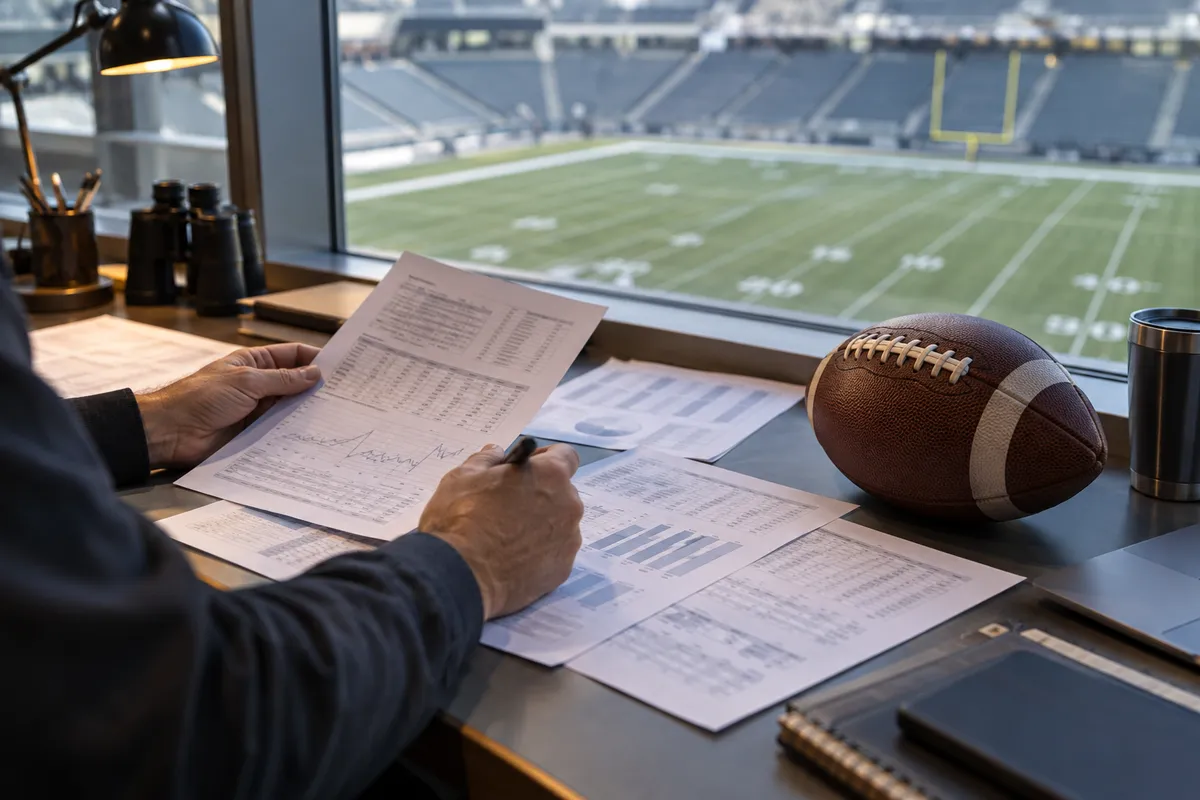
Every NFL season brings a flood of predictions: power rankings, win totals, playoff brackets. Most of them are hard to use. This guide gives you a short, repeatable method for judging any forecast, so you can tell a useful read from a hot take.
The method comes from an unlikely place. C-SPAN aired a panel hosted by the National Journal Hotline in Washington, DC, in which analysts previewed the 2026 midterm elections, including race predictions and the key contests to watch. Politics is a different game, but the habits that make a forecast useful carry over to football. What follows is our own analysis, not anything those panelists said about the NFL.
Separate the prediction from the reasoning
A prediction is just a conclusion. The reasoning behind it is what you can actually test.
When an analyst picks a team to win its division, look for the "because." Is it quarterback stability? A schedule that looks soft? A healthy offensive line? If the pick comes with no reason, treat it as entertainment. If it comes with a reason, you can check that reason against what you see on the field each week.
A quick test
Ask one question of any pick: what would have to happen for this to be wrong? A good analyst can answer it in a sentence. A weak pick usually can't.
Find the "bellwether" games
Political panels spend time on the contests expected to signal the bigger picture, the races whose outcome tells you something beyond the result itself. Football has the same thing.
A bellwether game is one where the result says more than the score. Think of:
- Divisional matchups between teams expected to finish close, since they carry tiebreaker weight.
- Early tests against a strong opponent, which show whether a rebuilt unit actually works.
- Games where a new starter or coordinator's system is on display for the first time.
This is our framing, not an official list. The practical point is that you don't need to weigh all 17 games equally. Pick three or four per team that will tell you whether the preseason story is holding up.
Watch the vulnerable spots, not just the stars
Election previews tend to focus on the seats most likely to change hands. The football version is to ask where a team is most exposed.
Star players get the attention, but forecasts usually break down at the weak points: a thin secondary, a backup quarterback who has barely played, a line with no depth. When you read a team preview, skip to the section on weaknesses. If the analyst doesn't have one, find a different preview.
Remember that national storylines hit local situations differently
Political analysts often examine how big national issues play out differently in individual states and districts. A similar thing happens across the NFL. A league-wide trend, such as the way offenses are being designed or how teams value certain positions, does not help every roster equally.
Before accepting a broad claim about the league, ask how it applies to the specific team you're following. A trend that boosts one roster can expose another one that isn't built for it.
Treat early forecasts as a starting line
Predictions made before games are played are a snapshot. They reflect what was known on the day they were written. Injuries, trades and surprise performances will move the picture.
A healthy way to use them:
- Write down the pick and the reason before the season starts.
- Check in after four to six games and ask whether the reason still holds.
- Update your view, not just the result. If the reasoning failed, the pick was shaky even if it happened to land.
That third step is the one most fans skip. Getting a pick right for the wrong reason teaches you nothing.
Label what you know versus what you're guessing
Good analysts, in politics or football, keep facts and opinions apart. A team's record and a player's injury status are facts. "This team is a contender" is a judgment. Rumors about trades or contract talks should be treated as unconfirmed until a team or reliable outlet confirms them.
You can do the same when you talk football with friends. Say "I think," and mean it. You'll be more persuasive, and you'll be wrong less often in public.
The takeaway
Next time you see a bold NFL prediction, ask for the reason, find the weak spot, and pick a handful of games that will prove or disprove it. Then check back in a month and see whether the forecast earned your trust.